In medicine, a prosthesis (pl.: prostheses; from Ancient Greek: πρόσθεσις, romanized: prósthesis, lit. 'addition, application, attachment'), or a prosthetic implant, is an artificial device that replaces a missing body part, which may be lost through physical trauma, disease, or a condition present at birth (congenital disorder). Prostheses may restore the normal functions of the missing body part, or may perform a cosmetic function. A person who has undergone an amputation is sometimes referred to as an amputee, Rehabilitation for someone with an amputation is primarily coordinated by a physiatrist as part of an inter-disciplinary team consisting of physiatrists, prosthetists, nurses, physical therapists, and occupational therapists. Prostheses can be created by hand or with computer-aided design (CAD), a software interface that helps creators design and analyze the creation with computer-generated 2-D and 3-D graphics as well as analysis and optimization tools. == Types == A person's prosthetic device should be designed and assembled to meet their individual appearance and functional needs. Depending on personal circumstances, co-morbidities, budget or health insurance coverage, and access to medical care, decisions may need to balance aesthetics and function. In addition, for some individuals, a myoelectric device, a body-powered device, or an activity-specific device may be appropriate options. The person's future goals and vocational aspirations and potential capabilities may help them choose between one or more devices. Craniofacial prostheses include intra-oral and extra-oral prostheses. Extra-oral prostheses are further divided into hemifacial, auricular (ear), nasal, orbital and ocular. Intra-oral prostheses include dental prostheses, such as dentures, obturators, and dental implants. Prostheses of the neck include larynx substitutes, trachea and upper esophageal replacements, Some prostheses of the torso include breast prostheses which may be either single or bilateral, full breast devices or nipple prostheses. Penile prostheses are used to treat erectile dysfunction, perform phalloplasty procedures in men, and to build a new penis in female-to-male gender reassignment surgeries. === Limb prostheses === Limb prostheses include both upper- and lower-extremity prostheses. Upper-extremity prostheses are used at varying levels of amputation: forequarter, shoulder disarticulation, transhumeral prosthesis, elbow disarticulation, transradial prosthesis, wrist disarticulation, full hand, partial hand, finger, partial finger. A transradial prosthesis is an artificial limb that replaces an arm missing below the elbow. Upper limb prostheses can be categorized in three main categories: Passive devices, Body Powered devices, and Externally Powered (myoelectric) devices. Passive devices can either be passive hands, mainly used for cosmetic purposes, or passive tools, mainly used for specific activities (e.g. leisure or vocational). An extensive overview and classification of passive devices can be found in a literature review by Maat et.al. A passive device can be static, meaning the device has no movable parts, or it can be adjustable, meaning its configuration can be adjusted (e.g. adjustable hand opening). Despite the absence of active grasping, passive devices are very useful in bimanual tasks that require fixation or support of an object, or for gesticulation in social interaction. According to scientific data a third of the upper limb amputees worldwide use a passive prosthetic hand. Body Powered or cable-operated limbs work by attaching a harness and cable around the opposite shoulder of the damaged arm. A recent body-powered approach has explored the utilization of the user's breathing to power and control the prosthetic hand to help eliminate actuation cable and harness. The third category of available prosthetic devices comprises myoelectric arms. This particular class of devices distinguishes itself from the previous ones due to the inclusion of a battery system. This battery serves the dual purpose of providing energy for both actuation and sensing components. While actuation predominantly relies on motor or pneumatic systems, a variety of solutions have been explored for capturing muscle activity, including techniques such as Electromyography, Sonomyography, Myokinetic, and others. These methods function by detecting the minute electrical currents generated by contracted muscles during upper arm movement, typically employing electrodes or other suitable tools. Subsequently, these acquired signals are converted into gripping patterns or postures that the artificial hand will then execute. In the prosthetics industry, a trans-radial prosthetic arm is often referred to as a "BE" or below elbow prosthesis. Lower-extremity prostheses provide replacements at varying levels of amputation. These include hip disarticulation, transfemoral prosthesis, knee disarticulation, transtibial prosthesis, Syme's amputation, foot, partial foot, and toe. The two main subcategories of lower extremity prosthetic devices are trans-tibial (any amputation transecting the tibia bone or a congenital anomaly resulting in a tibial deficiency) and trans-femoral (any amputation transecting the femur bone or a congenital anomaly resulting in a femoral deficiency). A transfemoral prosthesis is an artificial limb that replaces a leg missing above the knee. Transfemoral amputees can have a very difficult time regaining normal movement. In general, a transfemoral amputee must use approximately 80% more energy to walk than a person with two whole legs. This is due to the complexities in movement associated with the knee. In newer and more improved designs, hydraulics, carbon fiber, mechanical linkages, motors, computer microprocessors, and innovative combinations of these technologies are employed to give more control to the user. In the prosthetics industry, a trans-femoral prosthetic leg is often referred to as an "AK" or above the knee prosthesis. A transtibial prosthesis is an artificial limb that replaces a leg missing below the knee. A transtibial amputee is usually able to regain normal movement more readily than someone with a transfemoral amputation, due in large part to retaining the knee, which allows for easier movement. Lower extremity prosthetics describe artificially replaced limbs located at the hip level or lower. In the prosthetics industry, a transtibial prosthetic leg is often referred to as a "BK" or below the knee prosthesis. Prostheses are manufactured and fit by clinical prosthetists. Prosthetists are healthcare professionals responsible for making, fitting, and adjusting prostheses and for lower limb prostheses will assess both gait and prosthetic alignment. Once a prosthesis has been fit and adjusted by a prosthetist, a rehabilitation physiotherapist (called physical therapist in America) will help teach a new prosthetic user to walk with a leg prosthesis. To do so, the physical therapist may provide verbal instructions and may also help guide the person using touch or tactile cues. This may be done in a clinic or home. There is some research suggesting that such training in the home may be more successful if the treatment includes the use of a treadmill. Using a treadmill, along with the physical therapy treatment, helps the person to experience many of the challenges of walking with a prosthesis. In the United Kingdom, 75% of lower limb amputations are performed due to inadequate circulation (dysvascularity). This condition is often associated with many other medical conditions (co-morbidities) including diabetes and heart disease that may make it a challenge to recover and use a prosthetic limb to regain mobility and independence. For people who have inadequate circulation and have lost a lower limb, there is insufficient evidence due to a lack of research, to inform them regarding their choice of prosthetic rehabilitation approaches. Lower extremity prostheses are often categorized by the level of amputation or after the name of a surgeon: Transfemoral (Above-knee) Transtibial (Below-knee) Ankle disarticulation (more commonly known as Syme's amputation) Knee disarticulation (also see knee replacement) Hip disarticulation, (also see hip replacement) Hemi-pelvictomy Partial foot amputations (Pirogoff, Talo-Navicular and Calcaneo-cuboid (Chopart), Tarso-metatarsal (Lisfranc), Trans-metatarsal, Metatarsal-phalangeal, Ray amputations, toe amputations). Van Nes rotationplasty ==== Prosthetic raw materials ==== Prosthetic are made lightweight for better convenience for the amputee. Some of these materials include: Plastics: Polyethylene Polypropylene Acrylics Polyurethane Wood (early prosthetics) Rubber (early prosthetics) Lightweight metals: Aluminum Composites: Carbon fiber reinforced polymers Wheeled prostheses have also been used extensively in the rehabilitation of injured domestic animals, including dogs, cats, pigs, rabbits, and
Concept drift
In predictive analytics, data science, machine learning and related fields, concept drift or drift is an evolution of data that invalidates the data model. It happens when the statistical properties of the target variable, which the model is trying to predict, change over time in unforeseen ways. This causes problems because the predictions become less accurate as time passes. Drift detection and drift adaptation are of paramount importance in the fields that involve dynamically changing data and data models. == Predictive model decay == In machine learning and predictive analytics this drift phenomenon is called concept drift. In machine learning, a common element of a data model are the statistical properties, such as probability distribution of the actual data. If they deviate from the statistical properties of the training data set, then the learned predictions may become invalid, if the drift is not addressed. == Data configuration decay == Another important area is software engineering, where three types of data drift affecting data fidelity may be recognized. Changes in the software environment ("infrastructure drift") may invalidate software infrastructure configuration. "Structural drift" happens when the data schema changes, which may invalidate databases. "Semantic drift" is changes in the meaning of data while the structure does not change. In many cases this may happen in complicated applications when many independent developers introduce changes without proper awareness of the effects of their changes in other areas of the software system. For many application systems, the nature of data on which they operate are subject to changes for various reasons, e.g., due to changes in business model, system updates, or switching the platform on which the system operates. In the case of cloud computing, infrastructure drift that may affect the applications running on cloud may be caused by the updates of cloud software. There are several types of detrimental effects of data drift on data fidelity. Data corrosion is passing the drifted data into the system undetected. Data loss happens when valid data are ignored due to non-conformance with the applied schema. Squandering is the phenomenon when new data fields are introduced upstream in the data processing pipeline, but somewhere downstream these data fields are absent. == Inconsistent data == "Data drift" may refer to the phenomenon when database records fail to match the real-world data due to the changes in the latter over time. This is a common problem with databases involving people, such as customers, employees, citizens, residents, etc. Human data drift may be caused by unrecorded changes in personal data, such as place of residence or name, as well as due to errors during data input. "Data drift" may also refer to inconsistency of data elements between several replicas of a database. The reasons can be difficult to identify. A simple drift detection is to run checksum regularly. However the remedy may be not so easy. == Examples == The behavior of the customers in an online shop may change over time. For example, if weekly merchandise sales are to be predicted, and a predictive model has been developed that works satisfactorily. The model may use inputs such as the amount of money spent on advertising, promotions being run, and other metrics that may affect sales. The model is likely to become less and less accurate over time – this is concept drift. In the merchandise sales application, one reason for concept drift may be seasonality, which means that shopping behavior changes seasonally. Perhaps there will be higher sales in the winter holiday season than during the summer, for example. Concept drift generally occurs when the covariates that comprise the data set begin to explain the variation of your target set less accurately — there may be some confounding variables that have emerged, and that one simply cannot account for, which renders the model accuracy to progressively decrease with time. Generally, it is advised to perform health checks as part of the post-production analysis and to re-train the model with new assumptions upon signs of concept drift. == Possible remedies == To prevent deterioration in prediction accuracy because of concept drift, reactive and tracking solutions can be adopted. Reactive solutions retrain the model in reaction to a triggering mechanism, such as a change-detection test or control charts from statistical process control, to explicitly detect concept drift as a change in the statistics of the data-generating process. When concept drift is detected, the current model is no longer up-to-date and must be replaced by a new one to restore prediction accuracy. A shortcoming of reactive approaches is that performance may decay until the change is detected. Tracking solutions seek to track the changes in the concept by continually updating the model. Methods for achieving this include online machine learning, frequent retraining on the most recently observed samples, and maintaining an ensemble of classifiers where one new classifier is trained on the most recent batch of examples and replaces the oldest classifier in the ensemble. Contextual information, when available, can be used to better explain the causes of the concept drift: for instance, in the sales prediction application, concept drift might be compensated by adding information about the season to the model. By providing information about the time of the year, the rate of deterioration of your model is likely to decrease, but concept drift is unlikely to be eliminated altogether. This is because actual shopping behavior does not follow any static, finite model. New factors may arise at any time that influence shopping behavior, the influence of the known factors or their interactions may change. Concept drift cannot be avoided for complex phenomena that are not governed by fixed laws of nature. All processes that arise from human activity, such as socioeconomic processes, and biological processes are likely to experience concept drift. Therefore, periodic retraining, also known as refreshing, of any model is necessary. === Remedy methods === DDM (Drift Detection Method): detects drift by monitoring the model's error rate over time. When the error rate passes a set threshold, it enters a warning phase, and if it passes another threshold, it enters a drift phase. EDDM (Early Drift Detection Method): improves DDM's detection rate by tracking the average distance between two errors instead of only the error rate. ADWIN (Adaptive Windowing): dynamically stores a window of recent data and warns the user if it detects a significant change between the statistics of the window's earlier data compared to more recent data. KSWIN (Kolmogorov–Smirnov Windowing): detects drift based on the Kolmogorov-Smirnov statistical test. DDM and EDDM: Concept Drift Detection online supervised methods that rely on sequential error monitoring to estimate the evolving error rate. ADWIN and KSWIN: Windowing maintain a "window", a subset of the most recent data, of the data stream, which it checks for statistical differences across the window. == Applications in security == Concept drift is a recurring issue in security analytics, especially in malware and intrusion detection. In these systems, models are often trained on past logs, binaries or network traces, but the behaviour of attackers changes over time as new malware families, obfuscation techniques and campaigns appear. When the data no longer resemble the training set, the decision boundaries learned by classifiers or anomaly detectors can become misaligned with the current threat landscape and detection performance can drop unless the models are updated or replaced. Several studies on Windows malware model detection as an evolving data stream and track how performance changes as time passes. They show that classifiers trained on a fixed time window can perform well on nearby data but deteriorate quickly when evaluated on samples collected months or years later, even when large amounts of training data are available. In order to keep up with this, security systems often use sliding or adaptive windows, which restrict training to the most recent portion of the data so that older, less relevant examples are gradually discarded. They also employ drift detectors such as ADWIN and KSWIN that monitor error rates or changes in the distribution of recent observations and signal when the statistics of the incoming stream differ significantly from the past, prompting retraining or model replacement. Related problems appear in spam filtering, fraud detection and intrusion detection, where adversaries change content, patterns of activity or network behavior to evade models trained on historical data. In these settings drift can be gradual, as new types of spam or fraud emerge, or abrupt, after a sudden shift in attack techniques. Common strategies to remain eff
Collocation extraction
Collocation extraction is the task of using a computer to extract collocations automatically from a corpus. The traditional method of performing collocation extraction is to find a formula based on the statistical quantities of those words to calculate a score associated to every word pairs. Proposed formulas are mutual information, t-test, z test, chi-squared test and likelihood ratio. Within the area of corpus linguistics, collocation is defined as a sequence of words or terms which co-occur more often than would be expected by chance. 'Crystal clear', 'middle management', 'nuclear family', and 'cosmetic surgery' are examples of collocated pairs of words. Some words are often found together because they make up a compound noun, for example 'riding boots' or 'motor cyclist' or ‘collocation extraction’ its very self.
Best AI Chatbots in 2026
Curious about the best AI chatbot? An AI chatbot is software that uses machine learning to help you get more done — it combines speed, accuracy, and an interface that just works. Hands-on testing shows real-world results vary, so a short free trial is the smartest way to decide. Whether you are a beginner or a pro, the right AI chatbot slots into your workflow and pays for itself fast. This guide breaks down the top picks, their pros and cons, and who each one is best for.
Pumping lemma for regular languages
In the theory of formal languages, the pumping lemma for regular languages is a lemma that describes an essential property of all regular languages. Informally, it says that all sufficiently long strings in a regular language may be pumped—that is, have a middle section of the string repeated an arbitrary number of times—to produce a new string that is also part of the language. The pumping lemma is useful for proving that a specific language is not a regular language, by showing that the language does not have the property. Specifically, the pumping lemma says that for any regular language L {\displaystyle L} , there exists a constant p {\displaystyle p} such that any string w {\displaystyle w} in L {\displaystyle L} with length at least p {\displaystyle p} can be split into three substrings x {\displaystyle x} , y {\displaystyle y} and z {\displaystyle z} ( w = x y z {\displaystyle w=xyz} , with y {\displaystyle y} being non-empty), such that the strings x z , x y z , x y y z , x y y y z , . . . {\displaystyle xz,xyz,xyyz,xyyyz,...} are also in L {\displaystyle L} . The process of repeating y {\displaystyle y} zero or more times is known as "pumping". Moreover, the pumping lemma guarantees that the length of x y {\displaystyle xy} will be at most p {\displaystyle p} , thus giving a "small" substring x y {\displaystyle xy} that has the desired property. Languages with a finite number of strings vacuously satisfy the pumping lemma by having p {\displaystyle p} equal to the maximum string length in L {\displaystyle L} plus one. By doing so, no strings at all in L {\displaystyle L} have length at least p {\displaystyle p} . The pumping lemma was first proven by Michael Rabin and Dana Scott in 1959, and rediscovered shortly after by Yehoshua Bar-Hillel, Micha A. Perles, and Eli Shamir in 1961, as a simplification of their pumping lemma for context-free languages. == Formal statement == Let L {\displaystyle L} be a regular language. Then there exists an integer p ≥ 1 {\displaystyle p\geq 1} depending only on L {\displaystyle L} such that every string w {\displaystyle w} in L {\displaystyle L} of length at least p {\displaystyle p} ( p {\displaystyle p} is called the "pumping length") can be written as w = x y z {\displaystyle w=xyz} (i.e., w {\displaystyle w} can be divided into three substrings), satisfying the following conditions: | y | ≥ 1 {\displaystyle |y|\geq 1} | x y | ≤ p {\displaystyle |xy|\leq p} ( ∀ n ≥ 0 ) ( x y n z ∈ L ) {\displaystyle (\forall n\geq 0)(xy^{n}z\in L)} y {\displaystyle y} is the substring that can be pumped (removed or repeated any number of times, and the resulting string is always in L {\displaystyle L} ). (1) means the loop y {\displaystyle y} to be pumped must be of length at least one, that is, not an empty string; (2) means the loop must occur within the first p {\displaystyle p} characters. | x | {\displaystyle |x|} must be smaller than p {\displaystyle p} (conclusion of (1) and (2)), but apart from that, there is no restriction on x {\displaystyle x} and z {\displaystyle z} . In simple words, for any regular language L {\displaystyle L} , any sufficiently long string w {\displaystyle w} (in L {\displaystyle L} ) can be split into 3 parts, i.e. w = x y z {\displaystyle w=xyz} , such that all the strings x y n z {\displaystyle xy^{n}z} for n ≥ 0 {\displaystyle n\geq 0} are also in L {\displaystyle L} . Below is a formal expression of the pumping lemma. ∀ L ⊆ Σ ∗ , regular ( L ) ⟹ ∃ p ≥ 1 , ∀ w ∈ L , | w | ≥ p ⟹ ∃ x , y , z ∈ Σ ∗ , ( w = x y z ) ∧ ( | y | ≥ 1 ) ∧ ( | x y | ≤ p ) ∧ ( ∀ n ≥ 0 , x y n z ∈ L ) {\displaystyle {\begin{array}{l}\forall L\subseteq \Sigma ^{},{\mbox{regular}}(L)\implies \\\quad \exists p\geq 1,\forall w\in L,|w|\geq p\implies \\\qquad \exists x,y,z\in \Sigma ^{},(w=xyz)\land (|y|\geq 1)\land (|xy|\leq p)\land (\forall n\geq 0,xy^{n}z\in L)\end{array}}} == Use of the lemma to prove non-regularity == The pumping lemma is often used to prove that a particular language is non-regular: a proof by contradiction may consist of exhibiting a string (of the required length) in the language that lacks the property outlined in the pumping lemma. Example: The language L = { a n b n : n ≥ 0 } {\displaystyle L=\{a^{n}b^{n}:n\geq 0\}} over the alphabet Σ = { a , b } {\displaystyle \Sigma =\{a,b\}} can be shown to be non-regular as follows: Assume that some constant p ≥ 1 {\displaystyle p\geq 1} exists as required by the lemma. Let w {\displaystyle w} in L {\displaystyle L} be given by w = a p b p {\displaystyle w=a^{p}b^{p}} , which is a string longer than p {\displaystyle p} . By the pumping lemma, there must exist a decomposition w = x y z {\displaystyle w=xyz} with | x y | ≤ p {\displaystyle |xy|\leq p} and | y | ≥ 1 {\displaystyle |y|\geq 1} such that x y i z {\displaystyle xy^{i}z} in L {\displaystyle L} for every i ≥ 0 {\displaystyle i\geq 0} . Since | x y | ≤ p {\displaystyle |xy|\leq p} , the string y {\displaystyle y} only consists of instances of a {\displaystyle a} . Because | y | ≥ 1 {\displaystyle |y|\geq 1} , it contains at least one instance of the letter a {\displaystyle a} . Pumping y {\displaystyle y} to give x y 2 z {\displaystyle xy^{2}z} gives a word with more instances of the letter a {\displaystyle a} than the letter b {\displaystyle b} , since some instances of a {\displaystyle a} but none of b {\displaystyle b} were added. Therefore, x y 2 z {\displaystyle xy^{2}z} is not in L {\displaystyle L} which contradicts the pumping lemma. Therefore, L {\displaystyle L} cannot be regular. The proof that the language of balanced (i.e., properly nested) parentheses is not regular follows the same idea. Given p {\displaystyle p} , there is a string of balanced parentheses that begins with more than p {\displaystyle p} left parentheses, so that y {\displaystyle y} will consist entirely of left parentheses. By repeating y {\displaystyle y} , a string can be produced that does not contain the same number of left and right parentheses, and so they cannot be balanced. == Proof of the pumping lemma == For every regular language there is a finite-state automaton (FSA) that accepts the language. The number of states in such an FSA are counted and that count is used as the pumping length p {\displaystyle p} . For a string of length at least p {\displaystyle p} , let q 0 {\displaystyle q_{0}} be the start state and let q 1 , . . . , q p {\displaystyle q_{1},...,q_{p}} be the sequence of the next p {\displaystyle p} states visited as the string is emitted. Because the FSA has only p {\displaystyle p} states, within this sequence of p + 1 {\displaystyle p+1} visited states there must be at least one state that is repeated. Write q s {\displaystyle q_{s}} for such a state. The transitions that take the machine from the first encounter of state q s {\displaystyle q_{s}} to the second encounter of state q s {\displaystyle q_{s}} match some string. This string is called y {\displaystyle y} in the lemma, and since the machine will match a string without the y {\displaystyle y} portion, or with the string y {\displaystyle y} repeated any number of times, the conditions of the lemma are satisfied. For example, the following image shows an FSA. The FSA accepts the string: abcd. Since this string has a length at least as large as the number of states, which is four (so the total number of states that the machine passes through to scan abcd would be 5), the pigeonhole principle indicates that there must be at least one repeated state among the start state and the next four visited states. In this example, only q 1 {\displaystyle q_{1}} is a repeated state. Since the substring bc takes the machine through transitions that start at state q 1 {\displaystyle q_{1}} and end at state q 1 {\displaystyle q_{1}} , that portion could be repeated and the FSA would still accept, giving the string abcbcd. Alternatively, the bc portion could be removed and the FSA would still accept giving the string ad. In terms of the pumping lemma, the string abcd is broken into an x {\displaystyle x} portion a, a y {\displaystyle y} portion bc and a z {\displaystyle z} portion d. As a side remark, the problem of checking whether a given string can be accepted by a given nondeterministic finite automaton without visiting any state repeatedly, is NP hard. == General version of pumping lemma for regular languages == If a language L {\displaystyle L} is regular, then there exists a number p ≥ 1 {\displaystyle p\geq 1} (the pumping length) such that every string u w v {\displaystyle uwv} in L {\displaystyle L} with | w | ≥ p {\displaystyle |w|\geq p} can be written in the form u w v = u x y z v {\displaystyle uwv=uxyzv} with strings x {\displaystyle x} , y {\displaystyle y} and z {\displaystyle z} such that | x y | ≤ p {\displaystyle |xy|\leq p} , | y | ≥ 1 {\displaystyle |y|\geq 1} and u x y i z v {\displaystyle uxy^{i}zv} is in L {\displaystyle L} for every integer i ≥ 0 {\displaystyle i\geq 0} . From this, the above standard v
Automaton
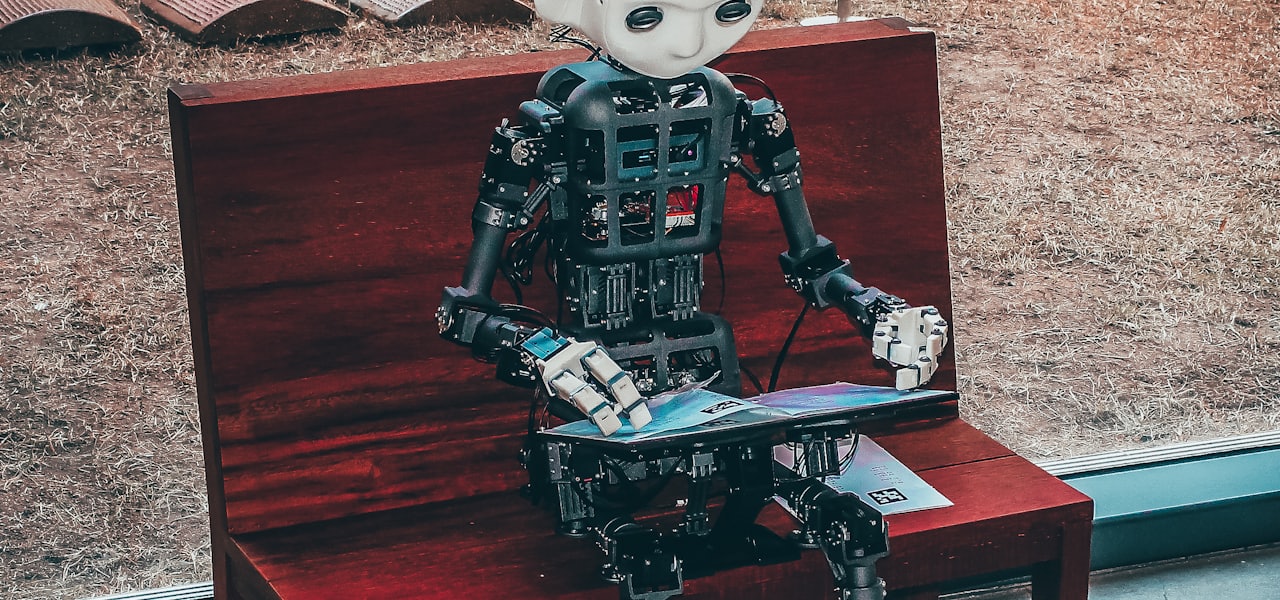
An automaton ( ; pl.: automata or automatons) is a relatively self-operating machine or control mechanism designed to automatically follow a sequence of operations or respond to predetermined instructions. Some automata, such as bellstrikers in mechanical clocks, are designed to give the illusion to the casual observer that they are operating under their own power or will, like a mechanical robot. The term has long been commonly associated with automated puppets that resemble moving humans or animals, built to impress and/or to entertain people. Animatronics are a modern type of automata with electronics, often used for the portrayal of characters or creatures in films and in theme park attractions. == Etymology == The word automaton is the latinization of the Ancient Greek automaton (αὐτόματον), which means "acting of one's own will". It was first used by Homer to describe an automatic door opening, or automatic movement of wheeled tripods. It is more often used to describe non-electronic moving machines, especially those that have been made to resemble human or animal actions, such as the jacks on old public striking clocks, or the cuckoo and any other animated figures on a cuckoo clock. == History == === Ancient === There are many examples of automata in Greek mythology: Hephaestus created automata for his workshop; Talos was an artificial man of bronze; King Alkinous of the Phaiakians employed gold and silver watchdogs. According to Aristotle, Daedalus used quicksilver to make his wooden statue of Aphrodite move. In other Greek legends he used quicksilver to install voice in his moving statues. The automata in the Hellenistic world were intended as tools, toys, religious spectacles, or prototypes for demonstrating basic scientific principles. Numerous water-powered automata were built by Ktesibios, a Greek inventor and the first head of the Great Library of Alexandria; for example, he "used water to sound a whistle and make a model owl move. He had invented the world's first 'cuckoo clock'". This tradition continued in Alexandria with inventors such as the Greek mathematician Hero of Alexandria (sometimes known as Heron), whose writings on hydraulics, pneumatics, and mechanics described siphons, a fire engine, a water organ, the aeolipile, and a programmable cart. Philo of Byzantium was famous for his inventions. Complex mechanical devices are known to have existed in Hellenistic Greece, though the only surviving example is the Antikythera mechanism, the earliest known analog computer. The clockwork is thought to have come originally from Rhodes, where there was apparently a tradition of mechanical engineering; the island was renowned for its automata; to quote Pindar's seventh Olympic Ode: The animated figures stand Adorning every public street And seem to breathe in stone, or move their marble feet. However, the information gleaned from recent scans of the fragments indicate that it may have come from the colonies of Corinth in Sicily and implies a connection with Archimedes. According to Jewish legend, King Solomon used his wisdom to design a throne with mechanical animals which hailed him as king when he ascended it; upon sitting down an eagle would place a crown upon his head, and a dove would bring him a Torah scroll. It is also said that when King Solomon stepped upon the throne, a mechanism was set in motion. As soon as he stepped upon the first step, a golden ox and a golden lion each stretched out one foot to support him and help him rise to the next step. On each side, the animals helped the King up until he was comfortably seated upon the throne. In ancient China, a curious account of automata is found in the Lie Zi text, believed to have originated around 400 BCE and compiled around the fourth century CE. Within it there is a description of a much earlier encounter between King Mu of Zhou (1023–957 BCE) and a mechanical engineer known as Yan Shi, an 'artificer'. The latter proudly presented the king with a very realistic and detailed life-size, human-shaped figure of his mechanical handiwork: The king stared at the figure in astonishment. It walked with rapid strides, moving its head up and down, so that anyone would have taken it for a live human being. The artificer touched its chin, and it began singing, perfectly in tune. He touched its hand, and it began posturing, keeping perfect time...As the performance was drawing to an end, the robot winked its eye and made advances to the ladies in attendance, whereupon the king became incensed and would have had Yen Shih [Yan Shi] executed on the spot had not the latter, in mortal fear, instantly taken the robot to pieces to let him see what it really was. And, indeed, it turned out to be only a construction of leather, wood, glue and lacquer, variously coloured white, black, red and blue. Examining it closely, the king found all the internal organs complete—liver, gall, heart, lungs, spleen, kidneys, stomach and intestines; and over these again, muscles, bones and limbs with their joints, skin, teeth and hair, all of them artificial...The king tried the effect of taking away the heart, and found that the mouth could no longer speak; he took away the liver and the eyes could no longer see; he took away the kidneys and the legs lost their power of locomotion. The king was delighted. Other notable examples of automata include Archytas' dove, mentioned by Aulus Gellius. Similar Chinese accounts of flying automata are written of the 5th century BC Mohist philosopher Mozi and his contemporary Lu Ban, who made artificial wooden birds (ma yuan) that could successfully fly according to the Han Fei Zi and other texts. === Medieval === The manufacturing tradition of automata continued in the Greek world well into the Middle Ages. On his visit to Constantinople in 949 ambassador Liutprand of Cremona described automata in the emperor Theophilos' palace, including "lions, made either of bronze or wood covered with gold, which struck the ground with their tails and roared with open mouth and quivering tongue," "a tree of gilded bronze, its branches filled with birds, likewise made of bronze gilded over, and these emitted cries appropriate to their species" and "the emperor's throne" itself, which "was made in such a cunning manner that at one moment it was down on the ground, while at another it rose higher and was to be seen up in the air." Similar automata in the throne room (singing birds, roaring and moving lions) were described by Luitprand's contemporary the Byzantine emperor Constantine Porphyrogenitus, in his book De Ceremoniis (Perì tês Basileíou Tákseōs). In the mid-8th century, the first wind powered automata were built: "statues that turned with the wind over the domes of the four gates and the palace complex of the Round City of Baghdad". The "public spectacle of wind-powered statues had its private counterpart in the 'Abbasid palaces where automata of various types were predominantly displayed." Also in the 8th century, the Muslim alchemist, Jābir ibn Hayyān (Geber), included recipes for constructing artificial snakes, scorpions, and humans that would be subject to their creator's control in his coded Book of Stones. In 827, Abbasid caliph al-Ma'mun had a silver and golden tree in his palace in Baghdad, which had the features of an automatic machine. There were metal birds that sang automatically on the swinging branches of this tree built by Muslim inventors and engineers. The Abbasid caliph al-Muqtadir also had a silver and golden tree in his palace in Baghdad in 917, with birds on it flapping their wings and singing. In the 9th century, the Banū Mūsā brothers invented a programmable automatic flute player and which they described in their Book of Ingenious Devices. Al-Jazari described complex programmable humanoid automata amongst other machines he designed and constructed in the Book of Knowledge of Ingenious Mechanical Devices in 1206. His automaton was a boat with four automatic musicians that floated on a lake to entertain guests at royal drinking parties. His mechanism had a programmable drum machine with pegs (cams) that bump into little levers that operate the percussion. The drummer could be made to play different rhythms and drum patterns if the pegs were moved around. Al-Jazari constructed a hand washing automaton first employing the flush mechanism now used in modern toilets. It features a female automaton standing by a basin filled with water. When the user pulls the lever, the water drains and the automaton refills the basin. His "peacock fountain" was another more sophisticated hand washing device featuring humanoid automata as servants who offer soap and towels. Mark E. Rosheim describes it as follows: "Pulling a plug on the peacock's tail releases water out of the beak; as the dirty water from the basin fills the hollow base a float rises and actuates a linkage which makes a servant figure appear from behind a door under the peacock and offer soap.
Devi Parikh
Devi Parikh is an American computer scientist. == Career == Parikh earned her PhD in Electrical and Computer Engineering at Carnegie Mellon University. She has served as a professor at Virginia Tech and Georgia Tech, and as of 2022 she is a research director at Meta. == Research == Parikh's research focuses on computer vision and natural language processing. In 2015, Parikh and her students at Virginia Tech worked on AI for Visual Question Answering (VQA). This technology allows users to ask questions about pictures, e.g. "Is this a vegetarian pizza?" Parikh's VQA dataset has been used to evaluate over 30 AI models. In 2017, Parikh published a conversational agent called ParlAI. In 2020, she developed an AI system that generates dance moves in sync with songs. In 2022, Parikh and a team at Meta developed Make-a-Video, a text-to-video AI model that is based on the diffusion algorithm. == Awards == 2017 IJCAI Computers and Thought Award 2011 ICCV Best-Paper Award ("Marr Prize")